
What Okfuskee County Probate Covers
Probate handles what a person owns and owes once they die. It proves a will, names someone to run the estate, pays valid debts, and passes what is left to the heirs. When there is no will, the court still steps in to divide the estate under state law. Okfuskee County probate records also reach beyond death cases. They include guardianships for minors and for adults who cannot manage their own affairs, conservatorships over property, and trust matters. Each of these is a court case with its own file, its own number, and its own docket of events.
There is one key point about how this works in Okfuskee County. The county has no separate probate court. Probate is a division of the Okfuskee County District Court, the same court that hears civil and criminal cases. A district judge or associate district judge presides. The display label most people use is still "probate records," but the venue is the District Court in Okemah. The Court Clerk opens the case, keeps the file, and issues the certified letters and orders that banks and title companies later ask to see.
Probate Terms Defined
Probate paperwork uses words that rarely come up in daily life. A short glossary makes an Okfuskee County probate file far easier to read. These terms appear on petitions, orders, and letters across most estate and guardianship cases.
- Testator
- The person who made the will. A testator sets out who should receive property and who should manage the estate.
- Executor
- The person named in the will to carry it out. Once the court approves, this role is often called the personal representative.
- Intestate
- Dying without a valid will. The estate then passes under Oklahoma's intestate succession rules rather than by the wishes in a will.
- Guardianship
- Court authority over the person or the affairs of a minor or an adult who cannot care for their own needs.
- Conservatorship
- Court authority focused on managing the money and property of a person who needs that help.
How to Search Okfuskee County Probate Records
Two state systems hold Okfuskee County probate records online. The first is On Demand Court Records, known as ODCR, which lists Okfuskee as a participating court with case data back to June 14, 1996 and hourly updates. The second is the Oklahoma State Courts Network, the statewide docket site. A name is enough to begin, and the format is last name first. If you know the case number, that finds the file faster than anything else.
- Open ODCR and set the court to Okfuskee, or pick Okfuskee County District Court on OSCN.
- Type the party name as "Last, First," using the decedent, petitioner, guardian, or trustee.
- Choose a probate case type to narrow the list, or enter a full case number such as a PB number when you have it.
- Use the filed-date filters to trim older estates from the results.
- Open a case to read the docket, the parties, and any notes about documents held at the Court Clerk's office.
Note: OSCN warns that its online data is not the official record, so a certified estate document must come from the Okfuskee County Court Clerk.
Okfuskee County Probate Case Types
The state court systems sort probate work into several case types. Picking the right one tightens any Okfuskee County probate records search. The list below mirrors the probate categories the court systems expose for the county. Each one opens a different kind of estate or protective file.
- Probate Proceedings: the main estate cases that admit a will or open an administration.
- Probate Miscellaneous Proceedings: side matters and special requests tied to estate work.
- Guardianships: cases that protect a minor or an adult who needs help.
- Conservatorship: cases focused on managing a protected person's property.
- Trust Proceedings: court matters that involve a trust and its trustee.
- Filing of Wills: the act of depositing a will with the court.
Most estate files carry a PB prefix in the case number, built from the prefix, the year, and a sequence. Guardianship and conservatorship files may use their own codes. When a name search returns too many results, the case type filter is the fastest way to find the right estate.
Recorded Probate Instruments in Okfuskee County
Court files are only one half of the picture. The County Clerk is a separate office that records land documents, and some of those documents grow out of an estate. The Okfuskee County Clerk records portal lets the public search recorded instruments by name, by book and page, and by instrument type. Indexed data reaches back to January 1992, and scanned images start in February 1993.
The instrument-type menu is unusually rich for estate research. It includes wills, heirship affidavits, letters testamentary, court orders, decrees, and trust documents. Transfer-on-death deeds and other recorded estate transfers can also appear there once they are filed. Searching by the decedent's name and a probate-related instrument type often turns up the recorded paper that proves title passed to an heir.
Note: Effective November 1, 2024, a state margin rule under SB57 sets a top margin of at least two inches on recorded documents, with other margins at least one inch.
The Oklahoma Small-Estate Affidavit
Not every estate needs a full probate case. Oklahoma law allows shorter paths for small estates, set out in Title 58, Probate Procedure. A small-estate affidavit can let an heir collect certain property without opening a formal estate in the District Court. This saves time and cost when the estate is modest and the heirs agree.
One common use is a vehicle. Service Oklahoma's small-estate affidavit transfers vehicle ownership when the total estate value is no more than $50,000. The threshold and the eligible property types matter, so the affidavit route does not fit every estate. When real estate, large accounts, or disputes are involved, a full probate case is usually the safer course. The Court Clerk can confirm what an affidavit covers and what still needs a judge.
Steps to Open an Okfuskee County Probate Case
A formal estate moves through clear stages once it begins. The path below shows how an Okfuskee County probate case tends to run from start to close. Timing varies with the size of the estate and whether anyone contests the will.
- Decide whether full probate is needed or whether a small-estate affidavit or transfer process is enough.
- File the probate petition in Okfuskee County District Court when the decedent lived there or held property there.
- The Court Clerk opens the case and assigns a case number.
- Notices go out, a creditor period runs, and the court sets hearings.
- The personal representative files an inventory, handles claims, and accounts for the estate.
- The judge enters orders and a final decree, then certified letters and orders come from the Court Clerk.
What Okfuskee County Probate Records Show
An Okfuskee County probate file builds up over the life of the case. Early on it holds the petition or application and the will, if one was filed. After that come the order admitting the will, the letters testamentary or letters of administration, and the notice to creditors. As the estate moves forward, the file gathers the inventory, the creditor claims, any sale orders, the accounting, and the final decree that closes the estate.
Guardianship and conservatorship files look a little different. They can include the petition, medical or capacity reports, the order appointing a guardian, and regular reports on the protected person. Because those reports may carry medical and financial detail, the court can limit who sees parts of the file. The online docket usually lists each event, while the underlying document may be marked as available at the Court Clerk's office rather than offered as a direct download.
Requesting Okfuskee County Probate Copies
When you need a certified letter, an order, or a full estate file, the Okfuskee County Court Clerk is the office to reach. The clerk keeps the official probate files, issues certified copies, and holds older estate files that were never scanned. Banks, title companies, and other courts usually want a certified copy signed by the clerk rather than a plain printout from a docket page.
Okfuskee County Court Clerk (Probate Division)
Court Clerk: Sherri Foreman
Okfuskee County Courthouse
209 North 3rd Street
Okemah, OK 74859
(918) 623-1724
ODCR-listed: (918) 623-0525
Fax: (918) 623-2687
Call before you mail anything. Confirm the right counter, the copy format you need, and the current fee, since a county probate fee sheet was not located in official sources. For recorded estate deeds and wills, the County Clerk handles those at the courthouse and through the okcountyrecords portal. Marriage and divorce questions tied to an estate route to the Okfuskee County marriage and divorce records office.
Okfuskee County Probate Filing Fees
Probate cases carry filing fees, copy fees, and publication costs. A county-specific probate fee schedule was not posted in the official sources reviewed for Okfuskee County. The table below frames the items most estates pay so a filer knows what to ask about. Each amount must be verified with the Court Clerk before filing or before sending payment.
| Item | Amount |
|---|---|
| Original probate petition or application | Verify with Court Clerk |
| Letters testamentary or letters of administration | Verify with Court Clerk |
| Certified copy per page | Verify with Court Clerk |
| Guardianship or conservatorship petition | Verify with Court Clerk |
| Notice to creditors publication | Verify with Court Clerk and newspaper |
Fee waivers may exist for filers who cannot pay. Oklahoma allows in forma pauperis requests in district court cases, and the Court Clerk can explain how that works for an estate. Always treat any fee figure from a third-party site with caution and confirm it at the source.
Restricted Okfuskee County Probate Records
Most probate filings are open to the public, but some details are not. Guardianship and conservatorship files often hold medical, capacity, and financial information about a protected person. The court can seal or limit access to those parts. Mental-health matters tied to a guardianship are sensitive and may be closed by statute or by court order.
Personal identifiers are another limit. Social Security numbers, account numbers, and similar data may be redacted or left out of public versions, in line with the state's e-filing identifier rules. Court records in Oklahoma are not sealed by mere preference. Under the Oklahoma Open Records Act, at 51 O.S. Section 24A.1 and following, public records stay open unless a statute or a court order closes them. When part of an estate file is restricted, ask the Court Clerk what is public and what needs party status or a judge's order to view.
Federal Bankruptcy and Estate Matters
Some money problems that come up around an estate are federal, not county, matters. A debt-heavy estate or a family member's bankruptcy is handled by the U.S. Bankruptcy Court for the Eastern District of Oklahoma, which serves Okfuskee County. Those cases never appear in the county probate system or on ODCR.
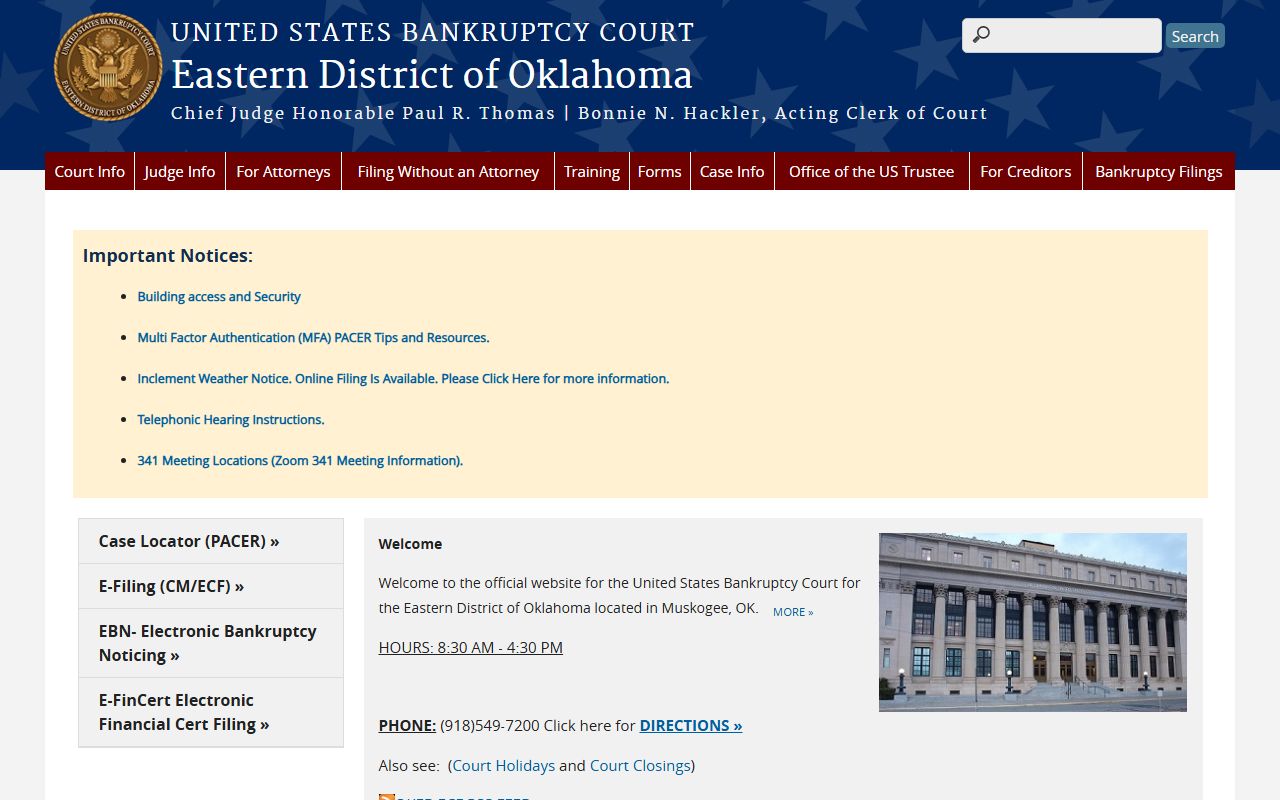
The bankruptcy court site explains how those federal filings work and how they differ from a county estate. A probate case settles what a person owned at death, while a bankruptcy case deals with debts under federal law, so the two run on separate tracks.
Federal court files are searched through a different tool. The PACER and CM/ECF lookup for the Eastern District of Oklahoma points to the right federal docket system. It is the path for federal bankruptcy and civil records, not for county estate files.
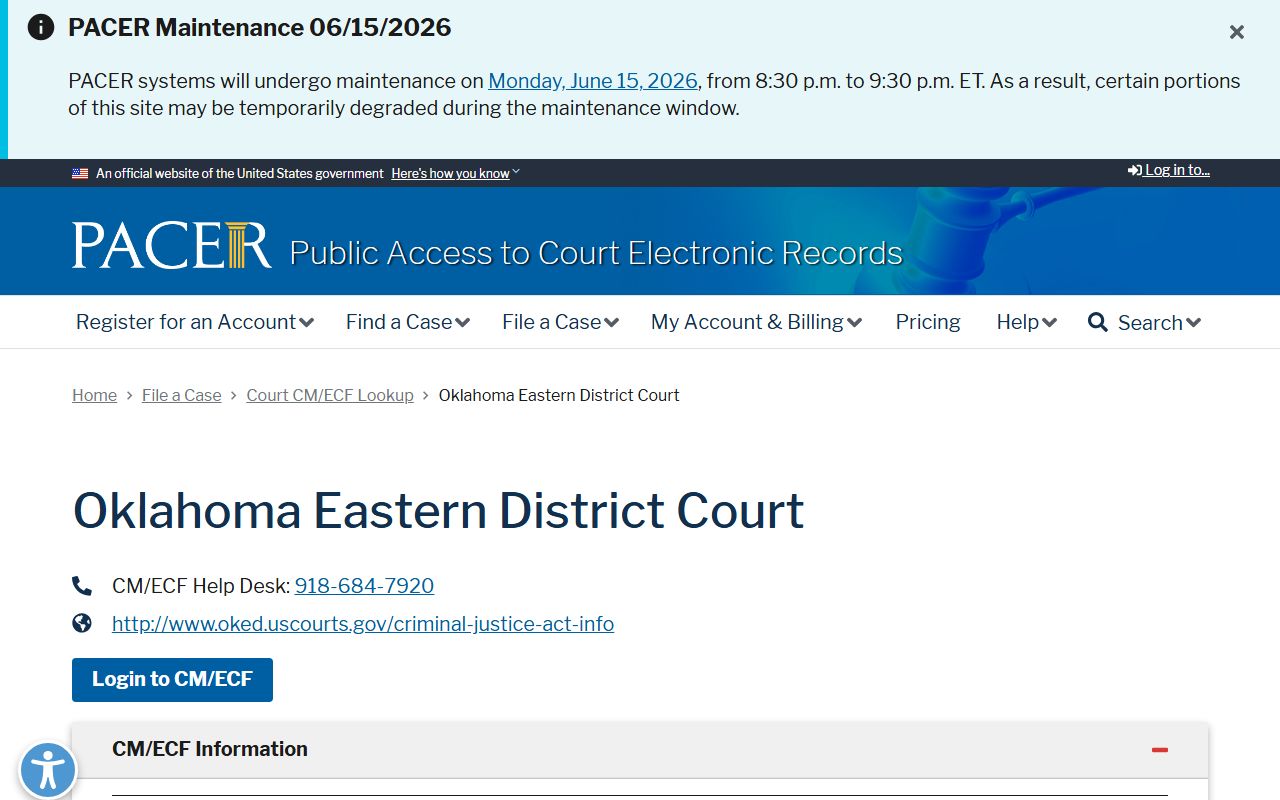
For ordinary Okfuskee County estates, wills, and guardianships, the District Court in Okemah remains the correct venue. Use PACER only when a matter is truly federal, and use the Court Clerk for everything filed under state probate law.