
Criminal Court Records in Okfuskee County
An Okfuskee County criminal court record is the case file the Court Clerk opens once the State files a charge. The Court Clerk, Sherri Foreman, keeps these files at the courthouse in Okemah. The file is the official home for the charge, the docket, and every order the judge signs. It starts on the day the case is filed. It grows with each hearing and each motion. By the end it shows the plea or the verdict, the disposition, and the sentence. The clerk holds both the paper file and the online docket entry.
The district court hears criminal cases in Okfuskee County. The county sits in Judicial District 24 with Creek County. Felony cases carry a CF prefix. Misdemeanor cases carry a CM prefix. A felony is the more serious class and can bring prison time. A misdemeanor is the lesser class and is capped at jail time or a fine. City ordinance crimes are different, and those route to the Okemah Municipal Court rather than the district court. ODCR also lists Criminal Probable Cause and Criminal Proceedings - Not Filed as case types, which can show the arrest-to-charge step before a formal CF or CM case opens.
How to Search Okfuskee County Criminal Court Records
Okfuskee County criminal court records have two online homes. The first is On Demand Court Records, or ODCR. ODCR lists Okfuskee as a participating court and reaches back to June 14, 1996, with hourly updates. The second is the Oklahoma State Courts Network, or OSCN, the statewide docket site. Both pull from the same district court. Start with a defendant name in last-name-first form, or a full case number when you have one.
- Open ODCR at odcr.com.
- Choose Okfuskee as the court, then enter the defendant name as "Last, First" or a case number.
- Narrow by case type, such as Criminal Felony or Criminal Misdemeanor, and by filed date.
- Open the case to read the docket, the counts, the plea, and the disposition.
- Request a certified copy from the Court Clerk when you need one for court or an agency.
Some detail reaches past the county file. Sentenced state prisoners appear in the Oklahoma Department of Corrections offender lookup, though the agency calls its data abbreviated and disclaims its accuracy. People who must register show up on the Oklahoma sex offender registry. The State, not a private party, brings these charges, and the statewide directory of Oklahoma district attorneys names the prosecutor for each county. The full list sits on the Oklahoma District Attorneys directory.
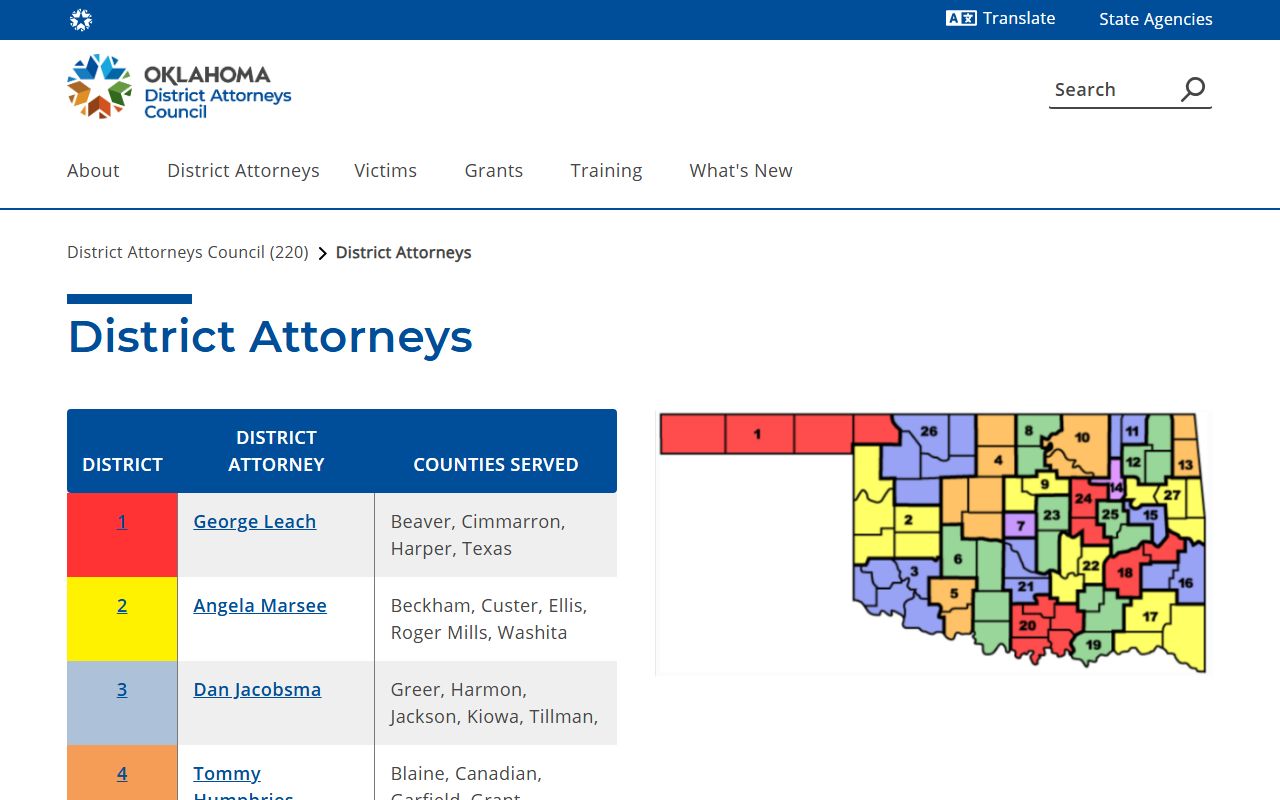
The directory confirms that Okfuskee County charges run through District 24, alongside Creek County. For a count-by-count look at what the prosecutor filed, the Okfuskee County arrest records and charges page sorts each charge by code and status.
Stages of an Okfuskee County Criminal Case
A criminal case moves through set steps, and each step leaves a mark on the record. The case opens when the State files the charge. The defendant is then brought before a judge to hear the charge and enter a plea. Pretrial work follows, where lawyers file motions and trade evidence. The case then ends in a plea or a trial. The judge enters the disposition, and a sentence follows a conviction. The docket logs each step with a date, so the file reads like a timeline.
Case flow: Charges Filed › Arraignment › Pretrial / Motions › Plea or Trial › Disposition › Sentencing
- Arraignment: the first court appearance, where the defendant hears the formal charge and enters a plea of guilty, not guilty, or no contest.
- Pretrial and motions: lawyers set bond, file motions, and exchange evidence, and the judge can rule on what a jury may hear.
- Plea or trial: most cases end in a plea, while the rest go to trial, where a judge or jury weighs the proof.
- Sentencing: after a guilty plea or a verdict, the judge imposes the sentence, such as prison, jail, probation, fines, or restitution.
What an Okfuskee County Criminal Court Record Shows
An Okfuskee County criminal court record holds far more than a name. Each field tells part of the story, from the charge as filed to the sentence the judge hands down. The public district court files use a steady set of fields. The table below lays out the core fields a criminal case file carries.
| Field | What It Shows |
|---|---|
| Case Number | Prefix, year, and sequence, such as CF-2024-00045 for a felony or CM for a misdemeanor. |
| Court and County | The District Court in and for Okfuskee County, Oklahoma. |
| Case Title | State of Oklahoma versus the named defendant. |
| Charges / Counts | Each offense listed as a separate count, with the statute and the charge text. |
| Arresting Agency / Officer | The agency and officer who made the arrest, plus any citation number. |
| Plea | The defendant's answer, such as guilty, not guilty, or nolo contendere. |
| Events | Docket entries like appearance, plea, warrant, judgment, and payment. |
| Bond | The amount and type of bond set for release. |
| Disposition | The final result of each count. |
| Sentence | The punishment, such as prison, jail, probation, fines, or restitution. |
| Fines and Costs | Line items for fines, court costs, and balances due. |
Many dockets note "Document Available at Court Clerk's Office" instead of a file you can open. The entry proves the document exists and tells you where to ask for it. The same case detail also feeds the broader Okfuskee County court records system, which covers civil, family, and probate files as well.
Charges vs. Convictions
A charge is not a conviction. The record can list a charge that was later dropped, dismissed, or that ended in an acquittal. A charge is only an accusation. A conviction is the finding of guilt, by plea or by verdict. Reading the disposition is the only safe way to tell them apart. A single file can carry several charges, where some end in conviction and others fall away.
| Charge | Conviction | |
|---|---|---|
| Stage | Accusation | Verdict or plea |
| Burden of Proof | Probable cause | Beyond reasonable doubt |
| Outcome Shown | Pending or resolved count | Guilt found and sentence set |
| Public Record | Yes | Yes |
Reading Okfuskee County Dispositions and Sentences
The disposition is the final word on each count. The sentence line shows the punishment that follows a conviction. It can list prison or jail time, probation, fines, court costs, and restitution to victims. A bench warrant event in the docket often points to a missed payment or a missed court date. The terms below show up again and again in Okfuskee County criminal files.
- Guilty
- The defendant admits the charge or a judge or jury finds guilt.
- Not Guilty
- The plea entered at arraignment, or a verdict that clears the count.
- Dismissed
- The court drops the count, so it ends without a conviction.
- Nolo Contendere
- A no-contest plea that accepts the penalty without admitting guilt.
- Deferred
- The judge holds off on a judgment while the defendant meets set terms.
A completed deferral can end without a final conviction, which is why the disposition line matters more than the charge text. Oklahoma uses deferred and suspended sentences in many cases. The docket spells out the terms, the review dates, and whether the defendant met them.
Sealed vs. Expunged Records
Oklahoma law lets some people clear an eligible record. Two terms get mixed up: sealed and expunged. A sealed record is hidden from public view but still exists. An expunged record is treated as though it never happened. Expungement runs through the district court under 22 O.S. Sections 18 and 19. An eligible person petitions the court, names the record, serves the required agencies, and attends any hearing the judge sets.
| Sealed | Expunged | |
|---|---|---|
| Visibility | Hidden from public | Destroyed / treated as never existed |
| Law Enforcement | Limited access | Very limited |
| Eligibility | Set by statute or court order under Title 22 | Granted by district court petition when the case qualifies under 22 O.S. 18-19 |
Sealing does not wipe a case from every private site. It changes what the official systems should disclose. Filing, service, and certified-copy fees for an expungement should be checked with the Okfuskee County Court Clerk, since a county fee sheet was not located.
Note: Online portals may drop a case after a sealing or expungement order, but only a certified order from the court proves the record was cleared.
Public Access to Okfuskee County Criminal Court Records
Oklahoma treats court records as open by default. The Oklahoma Open Records Act, at 51 O.S. Section 24A.1 and following, keeps public records open unless a statute or a court order closes them. The State files the charges that fill these records. In Okfuskee County, that work falls to District Attorney Max Cook, who serves District 24 for both Creek and Okfuskee counties.
The District 24 office detail sits on the Oklahoma District Attorneys Council District 24 page.
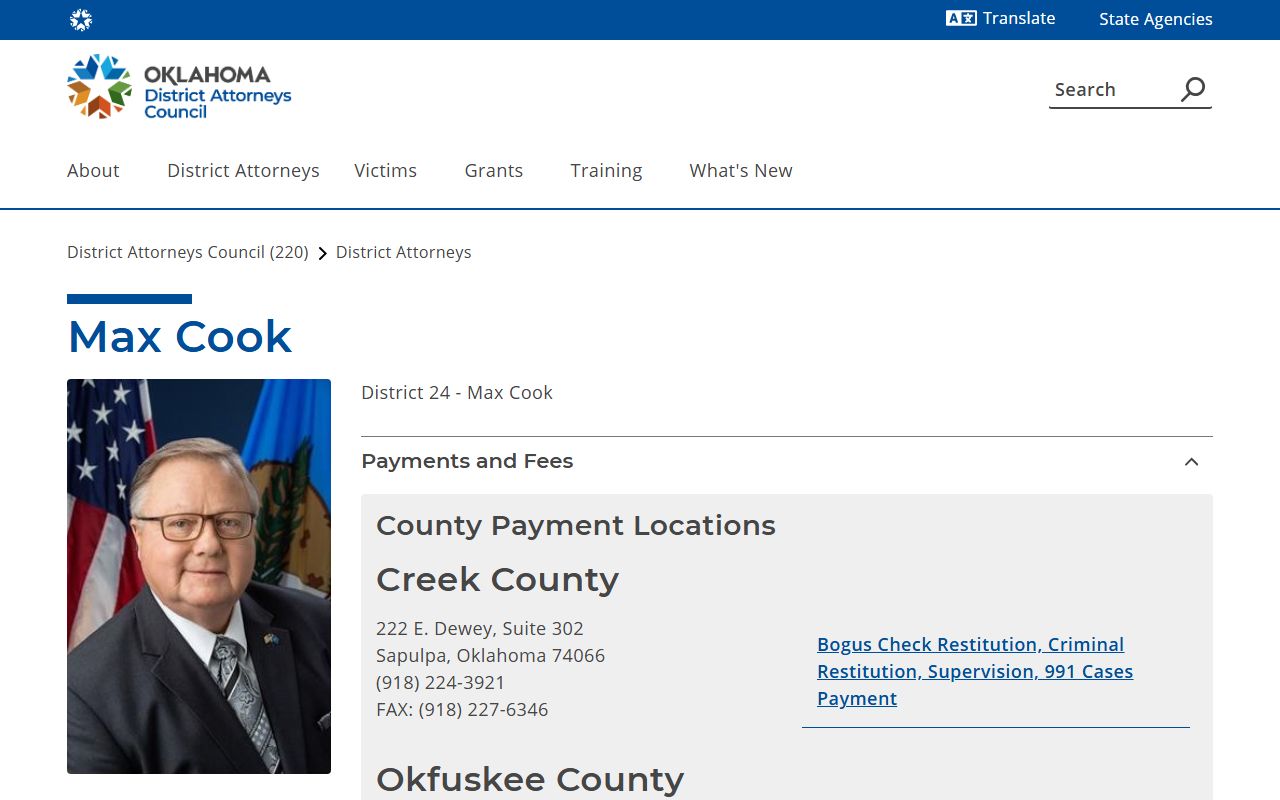
The District Attorney decides which charges to file and prosecutes them through the district court, which is why every case file traces back to that office. The Okfuskee office runs from the courthouse in Okemah, while a second office serves Creek County in Sapulpa.
Key Statutes:
Oklahoma Code § 51-24A.5 - sets how the public may inspect and copy records, subject to the law's exemptions.
Oklahoma Code § 51-24A.30 - court records are not sealed by mere preference; legal authority and a court order are what close a file.
Background Check Considerations
A criminal court record search is not the same as a regulated background check. A casual lookup on a court portal shows what is on the docket that day. A formal background check follows federal rules and pulls verified, dated data for hiring or housing. The two should not be mixed. An open count, a deferred sentence, or a dismissed charge can read very differently once the full disposition is checked.
Important: This site is not a consumer reporting agency under the Fair Credit Reporting Act, so its records cannot be used for credit, hiring, housing, or insurance screening.
Restricted Criminal Court Records in Okfuskee County
Some Okfuskee County criminal court records are closed or limited. Juvenile delinquency cases are not open the way adult criminal files are, and access may require party status, attorney status, or a court order. Sealed and expunged cases drop off the public portals after a qualifying order. Mental-health and commitment files are sensitive and often restricted. Personal identifiers, such as Social Security numbers, account numbers, and minor names, may be redacted or left out under the court's filing rules.
Open investigations are another limit. Under the Open Records Act, certain law-enforcement records can stay closed while a case is active. A record that is not online does not mean a record that does not exist. The fallback is a written request or a phone call to the Court Clerk, who can confirm whether a file is public, sealed, or held back by court order.